Computing Curriculum

a. Who leads this subject?

Computing Subject Specialist/Champion: Amanda Meager

Subject Team Governor: David Littlewood

Part of the STEM Curriculum Team.

Curriculum Design: Adopted curriculum from Purple Mash.


computingb. Computing Curriculum Intent

Developed as part of our Ambition Institute specialist curriculum training:

Technology is an integral part of everyday life, so at St Margaret’s we aim to prepare our children for a future in an environment which is heavily shaped by technology. Acquisition of computing skills are a major factor in enabling children to be confident, creative and independent learners; it is our intention to develop learners who are able to plan, design, create, program and evaluate information through the use of ICT and be able to apply the fundamental principles and concepts of computer science. We fully prepare pupils to live safely in an increasingly digital British society where pupils can evaluate and apply information technology, including new or unfamiliar technologies, analytically to solve problems.

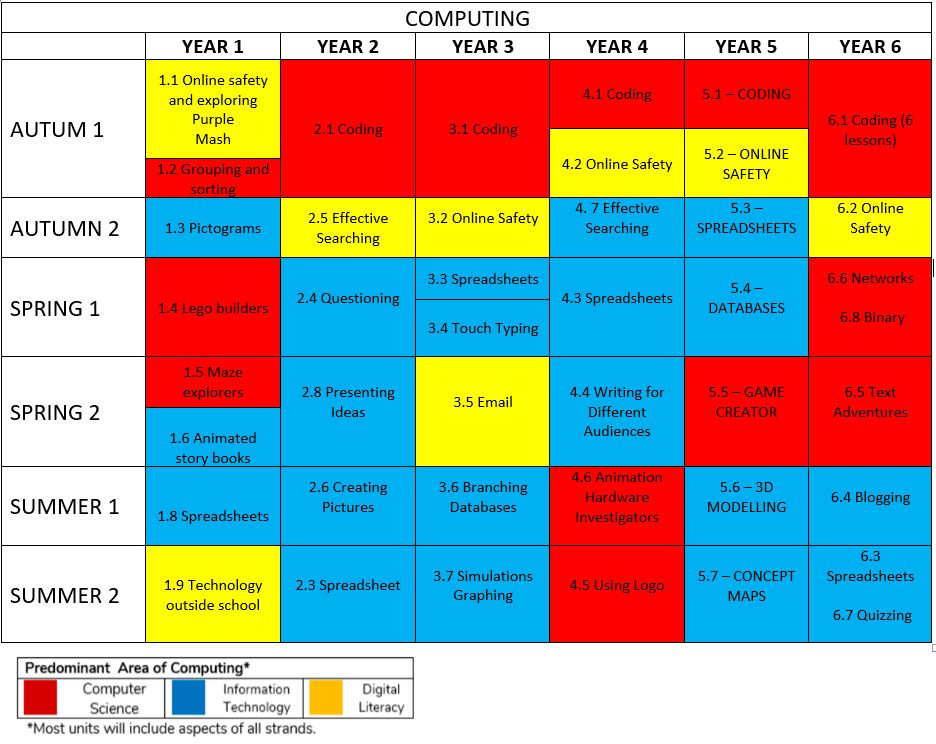
c. Computing Units (Top Level Coverage)
ict

d. Computing Knowledge Boards

Some aspects of our teaching are single subject based but our integrated subject approach ensures that we have the National Curriculum Coverage.

Our knowledge boards have been designed by our curriculum team of experts and secures the coverage and progression through our school.

Computing Knowledge Boards: 
kbcomp

https://drive.google.com/drive/folders/18mBKORM7hP6eS2h00Sx7V4DAU0NYknDj?usp=sharing

e. Spiritual. Moral, Social and Cultural education in Computing

SMSCinComputing


f. Computing National Curriculum Purpose

A high-quality computing education equips pupils to use computational thinking and creativity to understand and change the world. Computing has deep links with mathematics, science and design and technology, and provides insights into both natural and artificial systems. The core of computing is computer science, in which pupils are taught the principles of information and computation, how digital systems work and how to put this knowledge to use through programming. Building on this knowledge and understanding, pupils are equipped to use information technology to create programs, systems and a range of content. Computing also ensures that pupils become digitally literate – able to use, and express themselves and develop their ideas through, information and communication technology – at a level suitable for the future workplace and as active participants in a digital world.

g. Computing National Curriculum Aims

The aims for the Computing Curriculum are to ensure that all pupils:
• Can understand and apply the fundamental principles and concepts of computer science, including abstraction, logic, algorithms and data representation
• Can analyse problems in computational terms, and have repeated practical experience of writing computer programs in order to solve such problems
• Can evaluate and apply information technology, including new or unfamiliar technologies, analytically to solve problems
• Are responsible, competent, confident and creative users of information and communication technology.


Computing Curriculum

a. Who leads this subject?

Computing Subject Specialist/Champion: Amanda Meager

Subject Team Governor: David Littlewood

Part of the STEM Curriculum Team.

Curriculum Design: Adopted curriculum from Purple Mash.


computingb. Computing Curriculum Intent

Developed as part of our Ambition Institute specialist curriculum training:

Technology is an integral part of everyday life, so at St Margaret’s we aim to prepare our children for a future in an environment which is heavily shaped by technology. Acquisition of computing skills are a major factor in enabling children to be confident, creative and independent learners; it is our intention to develop learners who are able to plan, design, create, program and evaluate information through the use of ICT and be able to apply the fundamental principles and concepts of computer science. We fully prepare pupils to live safely in an increasingly digital British society where pupils can evaluate and apply information technology, including new or unfamiliar technologies, analytically to solve problems.

c. Computing Units (Top Level Coverage)

ict

d. Computing Knowledge Boards

Some aspects of our teaching are single subject based but our integrated subject approach ensures that we have the National Curriculum Coverage.

Our knowledge boards have been designed by our curriculum team of experts and secures the coverage and progression through our school.

Computing Knowledge Boards: 

kbcomp

https://drive.google.com/drive/folders/18mBKORM7hP6eS2h00Sx7V4DAU0NYknDj?usp=sharing

e. Spiritual. Moral, Social and Cultural education in Computing

SMSCinComputing


f. Computing National Curriculum Purpose

A high-quality computing education equips pupils to use computational thinking and creativity to understand and change the world. Computing has deep links with mathematics, science and design and technology, and provides insights into both natural and artificial systems. The core of computing is computer science, in which pupils are taught the principles of information and computation, how digital systems work and how to put this knowledge to use through programming. Building on this knowledge and understanding, pupils are equipped to use information technology to create programs, systems and a range of content. Computing also ensures that pupils become digitally literate – able to use, and express themselves and develop their ideas through, information and communication technology – at a level suitable for the future workplace and as active participants in a digital world.

g. Computing National Curriculum Aims

The aims for the Computing Curriculum are to ensure that all pupils:
• Can understand and apply the fundamental principles and concepts of computer science, including abstraction, logic, algorithms and data representation
• Can analyse problems in computational terms, and have repeated practical experience of writing computer programs in order to solve such problems
• Can evaluate and apply information technology, including new or unfamiliar technologies, analytically to solve problems
• Are responsible, competent, confident and creative users of information and communication technology.


Sign in

Translate this page

Care, Challenge and Celebrate with Christ - © 2016 - 2026 St Margarets CE Primary School. All rights reserved.
Address: School Road, Orford, Warrington, WA2 9AD | Telephone: 01925 634207  |  Executive Headteacher: Mr C M Metcalfe BEd (Hons) MA NPQH NPQEL
bronze 2022 26 generate-teaching-hub-logo.png Accent Music Ambassador logo YLA_LogoWO_Trans_CIRCLE.png mathshubs logo 32px liverpooldiocese ga-logo.png
Global
Neighbours
Award
2022-2026
Teaching
Sch Hub
Member
Ambassador
Status
Awarded
2016 & 2019
Pupils'
Awards
2015 - 2019
Turing
Maths Hub
Partner School
 
Subject
Association
Member School


Care, Challenge and Celebrate with Christ - © 2016 - 2026 St Margarets CE Primary School. All rights reserved.
Address: School Road, Orford, Warrington, WA2 9AD | Telephone: 01925 634207  |  Executive Headteacher: Mr C M Metcalfe BEd (Hons) MA NPQH NPQEL FCCT
wtsa   aboyaward    Accent Music Ambassador logo   childuniversity   mathshubs logo 32px  liverpooldiocese    ga logo
website design by WYNCHCO